

For the modern CEO, human capital is no longer just a “support function.” It is often the largest line item on the balance sheet and the most significant variable in operational execution. Yet, while finance, supply chain, and marketing have embraced sophisticated predictive modeling to hedge against market volatility, HR has traditionally remained trapped in “descriptive reporting.” Descriptive reporting tells you that turnover was 15% last year—it is a post-mortem of a failure that has already occurred. It offers zero utility for future-proofing an organization against the aggressive talent poaching seen in emerging markets.
Predictive HR analytics represents the transition from hindsight to foresight. It uses historical data, machine learning, and statistical modeling to forecast future outcomes, answering the high-stakes questions that determine market competitiveness: Which critical roles will be vacant in six months? Which candidates correlate with high performance in our specific culture? And how will a 10% increase in compensation affect long-term retention compared to an equivalent investment in professional development?
In rapidly expanding economies—most notably Guyana’s current oil-driven transformation—the luxury of reactive management has vanished. When talent is the primary bottleneck to scaling, the ability to predict and prevent shortages becomes a critical competitive moat. This guide moves beyond the buzzwords to provide a blueprint for turning your people data into a predictive engine.
TL;DR: Executive Insights on Predictive HR Analytics
- The Strategic Shift: Moving from descriptive analytics (what happened) to predictive analytics (what will happen) allows leadership to mitigate risks before they impact the P&L.
- The Financial Reality: Replacing a high-performer costs between 50% and 200% of their annual salary. Predictive models identify "flight risk" before the resignation letter is written.
- The Maturity Framework: Successful implementation follows a clear path: Data Centralization > Diagnostic Analysis > Predictive Modeling > Prescriptive Action.
- The Operational Context: In Guyana’s high-velocity market, analytics are the only way to navigate "brain circulation" and strict local content mandates simultaneously.
- CEO Action Step: Audit your data integrity today. If you cannot identify which 10% of your critical talent is likely to leave in the next two quarters, your strategy is currently reactive.
The Business Problem: The Hidden Math of "Talent Debt"
Relying on intuition for HR decisions is an expensive vestige of a slower era. When CEOs are making a hiring or retention decision based on “gut feel,” they are essentially gambling with the company’s most expensive resource. The financial implications of failing to utilize predictive HR analytics are measurable and compounding.
The true “all-in” cost of turnover is what economists call **Talent Debt.** Data from Gallup’s “Trillion Dollar Problem” report indicates that the cost of replacing an individual employee can range from one-half to two times the employee’s annual salary. In high-stakes sectors like offshore energy or specialized engineering, the loss of a single lead technician doesn’t just cost a recruitment fee; it costs hundreds of thousands of dollars in “Onboarding Lag”—the period where a new hire is drawing a salary but is not yet fully productive.
In a high-growth environment like Guyana, where the International Labour Organization (ILO) actively monitors labor shortages and underutilization, the “talent premium” paid to poach urgent replacements often creates an inflationary wage spiral. Predictive analytics serves as the only hedge against this volatility, allowing CEOs to see the “labor cliff” coming long before they fall off it.
Identifying the "DNA of Attrition"
Predictive models identify “flight risk” indicators that are invisible to the naked eye. Research from Gallup’s 2025 Global Workplace report indicates that global employee engagement has dipped to 21%, with “quiet quitting” becoming the default state for over half the workforce. When engagement drops, specific patterns emerge in the metadata: a delta in employee Net Promoter Scores (eNPS), subtle changes in PTO utilization patterns (the “burnout curve”), and increasing compensation lag relative to the rapidly shifting local market.
By flagging these patterns 90 to 180 days in advance, leadership can initiate “stay interviews” or adjusted development paths. This isn’t just about retention; it’s about protecting the “Succession Pipeline.” If your data predicts that a critical manager is likely to leave in Q4, and you have no internal replacement tracked at “Level 3 readiness,” you have a systemic risk that no amount of emergency capital can fix on short notice.
The Framework: A Four-Stage Model for Analytics Maturity
Transitioning to a data-driven HR function does not require a team of PhD data scientists on day one. It requires a systematic approach to how data is captured and utilized across four distinct stages of maturity.
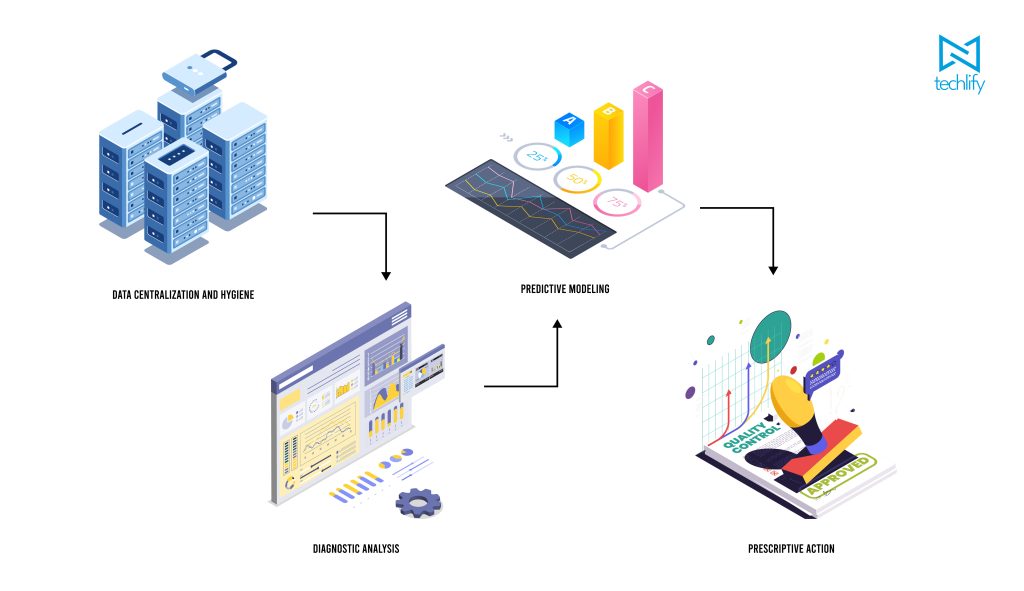
Stage 1: Data Centralization and Hygiene
Predictive models are only as reliable as the data feeding them (“Garbage In, Garbage Out”). Most organizations suffer from “Data Silos”: payroll is in one system, performance reviews are in Word documents on a manager’s laptop, and training records exist only in emails. Success begins with an integrated Employee Information System that serves as a single source of truth. Without clean, centralized data, any “prediction” is merely a sophisticated guess. CEOs must demand that HR data be as structured and accessible as financial data.
Stage 2: Diagnostic Analysis (The "Why")
Once data is centralized, leadership must move from what happened to why it happened. This involves correlating variables across departments. For example, did the 20% turnover in your logistics department correlate with a specific supervisor, a specific commute distance, or a lack of internal training opportunities? Diagnostic analysis might reveal that employees who complete three or more internal training modules in their first year are 50% less likely to leave. This insight turns HR into a profit-protection unit.
Stage 3: Predictive Modeling (The "What If")
This is where HR strategy meets business operations. Using historical patterns, the organization runs simulations. “If the price of oil stabilizes and we expand our Berbice operations by 15% in Q4, based on our current hiring velocity and churn rates, we will face a deficit of 8 certified safety officers.” This foresight enables the activation of either a “Build” strategy (upskilling current staff) or a “Buy” strategy (recruitment) months in advance of the crisis. It replaces “Panic Hiring” with “Strategic Acquisition.”
Stage 4: Prescriptive Action (The "So What")
The final stage of Predictive HR Analytics not only predicts a problem but also suggests the optimal solution. It might be recommended that, for a specific department, a flexible work-from-home policy would be 3x more effective for retention than a 5% salary bump. At this level, HR becomes a strategic consulting arm to the CEO, providing data-backed recommendations on how to allocate capital for maximum human output.
High-Impact Use Cases in High-Velocity Markets Like Guyana
In rapidly booming economies like Guyana, the traditional rules of HR are being rewritten by the sheer speed of economic development. Under the Guyana Local Content Act (2021), international oil companies and Tier-1 contractors are legally mandated to meet strict local employment quotas, effectively transforming qualified Guyanese professionals into a “scarce commodity” that multinationals must aggressively recruit to maintain their operating licenses. This demand is further intensified by the fact that Guyana has historically faced one of the world’s highest “brain drain” rates, with over 80% of its tertiary-educated population living abroad, allowing the remaining pool of highly skilled local talent to command international-level salaries and benefits.
Consequently, industry giants like ExxonMobil, SBM Offshore, and Halliburton are locked in a fierce “war for talent,” driving a cycle of “brain circulation” where top-tier technical and leadership professionals frequently move between multinationals to secure superior career opportunities and compensation packages. Predictive analytics is no longer a luxury; it is a required instrument for navigating three specific local realities:
- Strategic Workforce Forecasting and Local Content: Guyana’s Local Content Act requires increasing percentages of Guyanese nationals in technical and managerial roles. Predictive analytics tracks “time-to-readiness” for junior staff. By analyzing the speed at which employees move through competency tiers, the CEO can forecast exactly when the company can transition away from expensive expatriate labor without risking operational quality or compliance penalties.
- Managing “Brain Circulation”: Predictive models help firms understand the specific triggers that keep their “stars” in place. If the data shows that “career path clarity” and “leadership access” are higher retention drivers than “base salary” for your top 10%, you can shift investment from wage wars into robust Individual Development Plans (IDPs).
- Scaling for Project-Based Cycles: Much of Guyana’s growth is project-driven (infrastructure, energy, civil works). Predictive models allow you to scale your workforce up for peak phases and, more importantly, predict where those people can be redeployed internally once a project concludes. This avoids the “hire-and-fire” cycle that destroys an employer’s brand in a small, connected market.
Operationalizing Insights: Turning Dashboards into Decisions
Data is useless if it remains siloed in the HR department. To translate strategy into operational reality, predictive insights must be integrated into the organization’s monthly and quarterly governance.
The Quarterly Talent Audit
Just as the CFO presents a liquidity and cash flow report, the Head of People must present a Talent Capacity report. This audit should compare “Talent Inventory” against “3-Year Growth Targets.” If your expansion requires 50 new engineers but your data shows a 12-month hiring cycle for that role, you are already behind. Predictive analytics allows the CEO to adjust growth timelines based on human reality rather than financial fantasy.
Manager Risk Dashboards
Accountability for retention must move from the HR office to the direct supervisor. By providing frontline leaders with real-time “Risk Flags”—such as a high-performer who hasn’t received a performance review in 6 months or whose engagement scores have dipped—you empower them to intervene before the resignation letter is written. This is the difference between saving a relationship and conducting an exit interview.
L&D Investment Realignment
Most CEOs view Learning & Development (L&D) as a discretionary expense. Predictive analytics changes this. If models show that a specific technical certification reduces the time-to-productivity for new hires by 20%, the CEO can reallocate budget from headhunters to internal development with statistical confidence. You aren’t “spending money on training”; you are “purchasing operational speed.”
The Cultural Shift: From Compliance to Performance
Perhaps the most significant impact of predictive HR analytics is the cultural shift it triggers. In many legacy organizations, HR is viewed as the “Policy Police”—a department focused on compliance, benefits, and discipline. Predictive analytics rebrands the function as a Performance Engine.

When HR can predict which team structures will produce the highest output, or which leadership styles are driving the most value in the Guyanese context, they gain a permanent seat at the executive table. This shift requires the CEO to champion data literacy across the entire leadership team. It requires a move away from “we’ve always done it this way” toward “what does the data tell us is coming next?”
Conclusion: The First 90 Days
Predictive HR analytics is the bridge between human resource management and the CFO’s office. It transforms people management from an art into a science. In a high-growth economy like Guyana, the winners will be the leaders who stop guessing about their talent and start predicting their needs.
Strategic Next Step: Conduct a 90-minute “Talent Risk Audit” with your Head of HR and CFO. Put your 3-year expansion targets on one side and your current skills inventory on the other. Use the following three questions to guide the session:
- Which 5% of our workforce is “irreplaceable” in the next 12 months, and what is their statistically predicted flight risk?
- What is our “Time-to-Productivity” for new technical hires, and how does it impact our Q4 revenue targets?
- Do we have a centralized data source that allows us to see these trends in real-time, or are we relying on spreadsheets that are already six months out of date?
The gap you identify is the most important strategic document you will create this year. It is the roadmap for moving from a reactive cost center to a predictive powerhouse.
To learn how integrated HR technology can automate your predictive analytics and protect your growth trajectory, explore the TechlifyHR platform, engineered for the specific demands of the Guyanese business landscape.