

Every CEO and HR Director in a growing economy faces the same hard truth: your biggest bottleneck to growth isn’t capital or ideas, it’s talent.
You’ve secured contracts. The land for your new facility is ready. Your expansion plan into new markets is approved. Then someone asks: “Do we actually have the people to execute this?”
Too often, the answer is a frantic, expensive scramble.
This is exactly what strategic workforce planning solves. It’s the fundamental shift from reactive hiring to proactive talent building. For business leaders in Guyana—where sectors like oil & gas, construction, hospitality, and technology are moving at unprecedented speed—workforce planning isn’t HR theory. It’s survival.
TL;DR
- What it is: Aligning your people strategy with your 3-5 year business strategy to avoid talent shortages before they cripple growth.
- Why it matters: Companies without workforce planning face 40-50% hiring premiums, missed deadlines, burnout, and lost contracts. In Guyana's boom economy, talent is the bottleneck—not capital.
- The 4 steps: Audit current talent, forecast future needs, identify gaps, then close them using five levers (BUY, BUILD, BORROW, BRIDGE, BIND).
- Key insight: Your workforce plan must be reviewed quarterly in fast-moving economies, not annually. Use integrated HR systems to make planning operational, not theoretical.
- Action step: Schedule a 90-minute meeting with HR, CFO, and Ops. Compare your 3-year business plan against current team capabilities. That gap is your strategic workforce planning roadmap.
What is Strategic Workforce Planning?
Strategic workforce planning (SWP) is the process of aligning your people strategy with your business strategy, typically 3-5 years in advance. According to the Society for Human Resource Management (SHRM), it’s about working backwards from your long-term business goals to answer three critical questions:
- What skills and roles will we need?
- What talent do we currently have?
- How do we systematically close the gap?
Unlike traditional HR planning that reacts to immediate vacancies, strategic workforce planning is proactive. It treats your workforce as a strategic asset that requires the same level of planning as your capital investments, supply chain, or market expansion.
For Guyanese businesses competing in global markets, a robust workforce planning guide is essential. The nation’s unique challenges, from brain drain to rapid economic shifts in the oil-dependent sectors, make workforce forecasting not just valuable but critical.
Why Strategic Workforce Planning Matters Now
The cost of ignoring workforce planning is brutal and measurable:
- Missed Deadlines and Lost Revenue: Your shore base project in Guyana stalls for six months because you can't find qualified safety engineers and project managers. That delay costs you penalty clauses and reputation damage that takes years to repair.
- Budget Bloat: Without a talent pipeline, you're forced to poach experienced professionals at 40-50% premiums over market rate. This destroys your project margins and creates a mercenary culture where loyalty goes to the highest bidder.
- Burnout and Turnover: Your best people are stretched impossibly thin covering critical gaps. Within months, they burn out or get recruited away—creating two new problems for every one you failed to solve. The Gallup estimates that replacing leaders costs 200%, professionals 80%, and frontline employees 40% of their salary.
- Strategic Opportunities Lost: You're forced to pass on lucrative contracts because you honestly can't commit the skilled teams needed to deliver quality work on time.
- Competitive Disadvantage: While you're scrambling to fill basic roles, competitors with proper workforce planning are already training next-generation talent and expanding market share.
In Guyana’s historic economic boom driven by offshore oil discoveries, the “resource curse” risks becoming a “talent curse” where explosive growth gets choked not by lack of capital or opportunity, but by a fundamental shortage of trained, “ready to execute” people.
The Four-Step Workforce Planning Framework
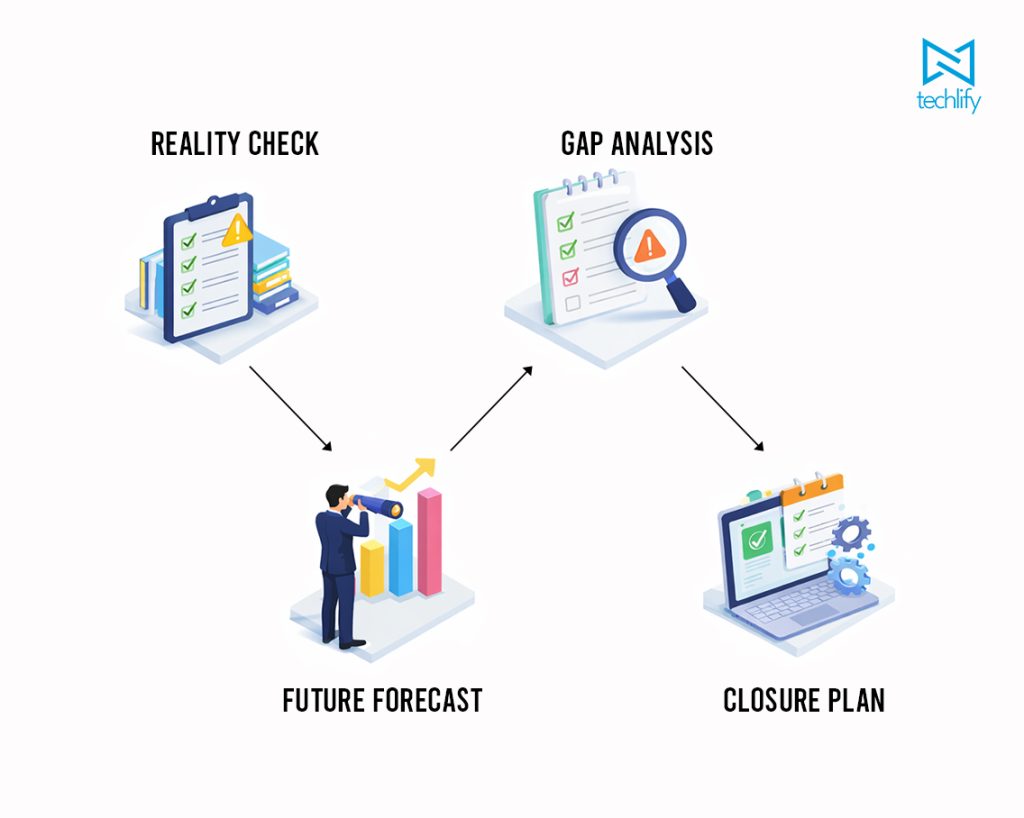
Effective strategic workforce planning doesn’t require complex consulting models or expensive software to start. It comes down to four straightforward steps that any leadership team can execute:
Step 1: Current State Assessment (The Reality Check)
Begin with a brutally honest audit of your current workforce. This isn’t just an employee headcount or org chart review. A proper skills gap analysis requires documenting:
- Core Competencies: What are the actual, proven skills of each team member? Not what their resume says, but what they can demonstrably do.
- Certifications and Credentials: Which roles require specific licenses or qualifications, and who currently holds them?
- Career Trajectory: What are each person's ambitions? Who is eyeing management? Who wants to stay technical?
- Retirement Timeline: How many of your senior engineers, accountants, or department heads are within 3 years of retirement?
- Flight Risk Assessment: In tight labor markets like Guyana's, be honest about who's likely to leave. High performers with portable skills and stagnant development paths are your highest risk.
This assessment creates your talent inventory—the foundation of all workforce planning. Without knowing what you actually have, you can’t plan what you need.
For organizations managing this data across multiple departments or branches, an integrated employee information system becomes essential for maintaining accurate, real-time workforce data.
Step 2: Future Demand Forecasting
Your future workforce needs to flow directly from your business strategy. This step requires tight alignment between HR, finance, and operations leadership.
Start by mapping your 3-year business plan to talent requirements:
- If you're opening two new coastal hospitality sites in New Amsterdam or Bartica, what's the headcount breakdown? How many experienced hotel managers, trained chefs, front desk staff, and maintenance personnel do you need?
- If you're scaling offshore rig operations, what technical certifications are non-negotiable? How many petroleum engineers, safety officers, and logistics coordinators will each new contract require?
- If you're expanding into e-commerce and digital services, what technical skills (cloud architecture, digital marketing, UX design) move from "nice to have" to "mission critical"?
Factor in external variables that will reshape your talent needs:
- Technology Disruption: Payroll automation software, HRIS tools, AI, and digital platforms will eliminate some roles while creating demand for new technical skills.
- Regulatory Changes: Guyana's local content policy, for example, mandates increasing percentages of Guyanese nationals in key positions. These requirements demand proactive workforce localization.
- Market Evolution: Consumer behavior shifts, new competitors, and changing customer expectations all reshape the skills your business needs to remain competitive.
This forecasting exercise transforms your business strategy into a concrete talent demand projection: “By Q2, we will need 12 additional certified project managers, 8 data analysts, and 25 skilled technicians.”
Step 3: Gap Analysis (Your Strategic To-Do List)

Now comes the clarity: subtract your current state (Step 1) from your future demand (Step 2). The result is your skills gap analysis—a prioritized list of critical talent gaps.
Your gap analysis might reveal:
- "We're short of 5 data-savvy logistics managers by Q3 2026."
- "40% of our senior engineering team is eligible for retirement within 18 months, with no succession plan."
- "We need 3 certified safety officers for the new contract, but currently have zero employees with that credential."
- "Our customer service team lacks anyone with digital platform management experience."
This isn’t a vague “we need better people” statement. It’s a specific, quantified inventory of exactly where your talent pipeline breaks down. This precision is what transforms workforce planning from theory into action.
Document not just the gaps, but their business impact and timeline urgency. A gap that threatens a major contract in 6 months requires different treatment than a nice-to-have skill for a 3-year initiative.
Step 4: Gap Closure Strategy (The Five Levers)
You have five strategic levers to close talent gaps. The best workforce planning strategies use all five in combination, not just defaulting to external recruitment:
BUY (Strategic Recruitment): External hiring for critical gaps where internal development isn’t fast enough. But make it strategic, not desperate. For Guyanese companies, this might mean targeted recruitment campaigns aimed at the Guyanese diaspora professionals with roots in Guyana who might return for the right opportunity. Partner with executive search firms that specialize in your industry and understand regional talent markets.
BUILD (Training and Development): Invest systematically in developing your existing workforce. This is particularly powerful in emerging economies where formal education systems may lag industry needs. Partner with institutions like the University of Guyana or GTTC (Government Technical Training Centre) to create custom training programs aligned to your specific skill gaps. Implement employee training management systems to track progress and measure ROI on training investments.
BORROW (Strategic Partnerships): Use experienced contractors, consultants, or strategic partnerships for specialized, project-based needs. This is especially effective for niche technical expertise you need periodically but can’t justify as full-time headcount. In resource sectors, partnering with international firms can provide knowledge transfer while you build internal capability.
BRIDGE (Internal Mobility and Succession): Look at your existing team through fresh eyes. Who could step into that senior role in 12 months with focused mentorship and stretch assignments? Internal mobility programs move people across departments to build breadth, create bench strength, and increase employee engagement. Implement formal succession planning for every critical role, with identified backups and development timelines.
BIND (Retention Strategy): Double down on keeping your stars. In tight labor markets, losing a high performer creates two problems: replacing their output and replacing their expertise. Audit why your best people would stay versus leave. Beyond competitive salaries, top talent stays for clear career paths, meaningful work, strong leadership, and recognition. Build retention programs targeting your highest-value, highest-risk employees.
The organizations that excel at workforce planning don’t rely on one lever. They orchestrate all five into a coherent talent strategy that builds organizational capability over time.
Strategic Workforce Planning in Guyana

Workforce planning for Guyanese businesses requires addressing nation-specific realities that global workforce planning models often miss:
The Speed of Economic Change
When ExxonMobil announces a new oil discovery off Georgetown, or when a major infrastructure development gets approved, the entire national talent market shifts overnight. Unlike mature economies, where change is incremental, Guyana’s economy can pivot dramatically in months.
Your workforce plan can’t be an annual exercise. It requires quarterly reviews at a minimum, with real-time adjustments as market conditions change. The agility to respond to opportunity is what separates national leaders from those left scrambling.
National Brain Circulation and Talent Competition
Top Guyanese talent is inherently mobile. A skilled engineer in Georgetown is evaluating opportunities not just locally, but internationally in Houston, Toronto, or London. Your employee value proposition must compete across these markets.
Retention isn’t just about salary—though compensation must be competitive. It’s about stability in a rapidly evolving economy, clear development paths, meaningful impact, and quality of life. Companies winning Guyana’s talent war are those telling compelling stories about building something significant in their home nation.
For mid-career professionals, the calculus includes: “Can I build my career here, or do I need to leave to reach my potential?” Answer that question clearly in favor of staying, and you’ll win.
The Resilience and Flexibility Factor
For agriculture, tourism, and construction businesses facing seasonal demand swings, workforce planning means building flexibility into your talent model. How do you maintain core expertise year-round while scaling capacity for peak seasons?
Strategies include cross-training employees to handle multiple roles, building a reliable pool of seasonal contractors, and structuring compensation to make variable schedules attractive. For time-sensitive industries, integrating time and attendance systems with workforce planning helps forecast labor costs and capacity accurately.
How HR Technology Enables Strategic Workforce Planning
A workforce plan trapped in PowerPoint slides and Excel spreadsheets is basically worthless. It needs to live in the daily operational rhythm of your business. This is where HR technology shifts from administrative convenience to strategic enabler.
An integrated HR Information System (HRIS) serves as the central nervous system for your workforce planning by:
- Real-Time Workforce Analytics: Providing live dashboards showing skills inventory, tenure distribution, certification expiration dates, and flight risk indicators across your entire organization. You can't manage what you can't measure.
- Scenario Modeling: Enabling "what-if" analysis: "If we win the Vreed-en-Hoop shore base contract, what roles do we need, when do we need them, and do we have internal candidates?" Model different growth scenarios against your current workforce to stress-test your talent capacity.
- Automated Succession Workflows: Making succession planning an active process, not a forgotten initiative. Identify successors for critical roles, assign development activities, track progress, and get alerted when timelines are at risk.
- Skills Gap Tracking: Continuously measuring the gap between required competencies and current workforce capabilities, with clear visibility into which training programs or hiring initiatives are actually closing gaps.
For organizations serious about workforce planning, platforms like TechlifyHR integrate employee data, payroll management, training records, and performance data into unified strategic workforce planning capabilities tailored to Guyanese business realities.
Common Strategic Workforce Planning Mistakes to Avoid
Even organizations that attempt workforce planning often stumble on predictable mistakes:
- Treating it as an HR Exercise: Workforce planning is a business strategy problem that requires CEO and CFO engagement, not just HR. If your executive team isn't driving it, it will fail.
- Planning in a Vacuum: Building workforce plans disconnected from actual business strategy leads to talent investments that don't align with where the business is actually going.
- Ignoring Retention: Focusing entirely on external hiring while your best people walk out the door is like filling a bathtub with the drain open.
- One-Time Exercise: Workforce planning is not a project with an end date. It's an ongoing strategic discipline that must adapt to changing business conditions.
- No Accountability: Without assigning ownership, timelines, and metrics to specific leaders, workforce planning becomes a nice document that gathers dust.
Your Next Step: Start Your Strategic Workforce Planning Now
Stop letting talent shortages ambush your growth strategy. Your next move is straightforward:
Schedule a 90-minute kickoff meeting for strategic workforce planning. Invite your Head of HR, CFO, and Operations lead. Put your 3-year business plan on one side of the table and an honest assessment of your current team’s capabilities on the other.
Ask the defining question: “Does this match?”
The gap you identify is the most important strategic document you’ll create this year. Closing that gap systematically is how you transform from a company that reacts to talent crises into one that proactively builds competitive advantage through superior workforce planning.
For organizations ready to move beyond spreadsheets, explore how integrated HR systems can transform workforce planning from an annual headache into a continuous strategic advantage.
The companies that will dominate Guyana’s next decade aren’t those with the most capital or the best connections. They’re the ones building talent strategies today for the markets they’ll compete in tomorrow.
Start planning now. Your competition already is.